
Open-mindedness - Willingness to Explore New Experiences
Becoming open to experience involves accepting who we are, the opportunities available, and the potential to develop

Previous: How to Motivate Employees in Learning and Development
We are often advised to be open-minded in order for learning and adapting those rapid changes in this world nowadays, from work to life but what exactly an open-minded person looks like?
Those people in high open-mindedness tend to show the following characteristics1:
Less likely to stereotype or prejudice against minority groups
More likely to enjoy novel experiences
Tend to vote center-left
Use more problem-focused coping strategies rather than emotion or avoidance-focused, especially in sports
More readily undertake challenging and arduous activities and events
More spiritual but less involved in organized religion
More ready to change their opinions based on new facts
All above are from research and it doesn’t mean you must have them all to show that you’re open-minded.
So what is open-mindedness?
Open-mindedness is one of values in actions under Knowledge and Wisdom virtue and defined as “Thinking things through and examining them from all sides; weighing all evidence fairly” in the VIA inventory. Crystal clear that we need to see things in a wide view and fairness. Open-mindedness doesn’t require us to immediately accept the thing, event or point of view that is being given, but helps us to have more objective view and opening up more opportunities to understand it.
The fundamentals of open-mindedness
Curiosity, love of learning and an creator’s imagination is vital to open-mindedness to have a big picture in your mind at a more equitable level before critical thinking if need.
Especially, such leaders are likely to be more curious and imaginative, accepting new ideas and absorbing novel information. Openness to experience is seen as having a positive effect on knowledge-exchanging behaviors, accelerating the speed of sharing and learning essential for team growth and development (Zhang, Sun, Jiang, & Zhang, 2019)2.
How to foster openness
Several essential behaviors, outlooks, and approaches can lead to increases in openness (Jarrett, 2021)3. Here are a few examples to try:
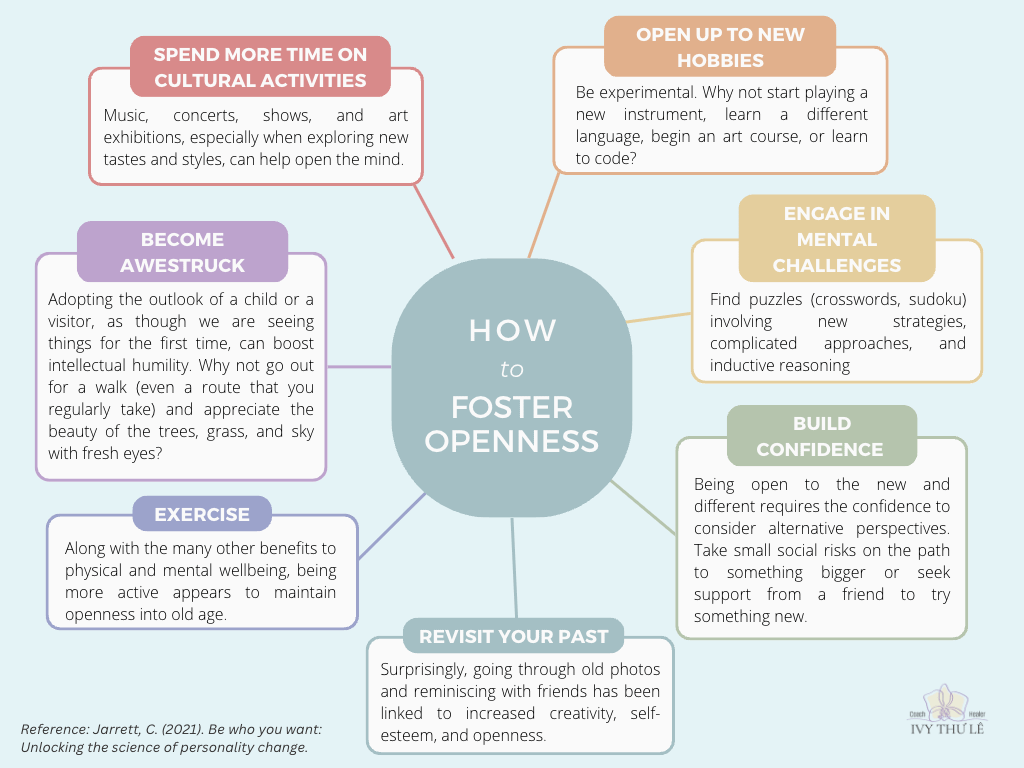
Spend more time on cultural activities.
Music, concerts, shows, and art exhibitions, especially when exploring new tastes and styles, can help open the mind.Open up to new hobbies, sports, and activities.
Be experimental. Why not start playing a new instrument, learn a different language, begin an art course, or learn to code?Engage in mental challenges.
Find puzzles (crosswords, sudoku) involving new strategies, complicated approaches, and inductive reasoning.Build confidence.
Being open to the new and different requires the confidence to consider alternative perspectives. Take small social risks on the path to something bigger or seek support from a friend to try something new.Revisit your past.
Surprisingly, going through old photos and reminiscing with friends has been linked to increased creativity, self-esteem, and openness.Regularly exercise.
Along with the many other benefits to physical and mental wellbeing, being more active appears to maintain openness into old age.Become awestruck.
Adopting the outlook of a child or a visitor, as though we are seeing things for the first time, can boost intellectual humility. Why not go out for a walk (even a route that you regularly take) and appreciate the beauty of the trees, grass, and sky with fresh eyes?
Becoming open to experience involves accepting who we are, the opportunities available, and the potential to develop. As a result, we can live a more fulfilling life while benefiting our psychological and physiological wellbeing.
Thank you for reading and if it finds you interesting or helpful, please feel free share to whom it might concern.
Next: Perspective
If you’re looking for a partner who could assist you on the journey of self-discovery and explore what you could do to find meaning in life and happiness, please do not hesitate to reach me - https://forms.gle/WhZ68XhR3oQJcSxDA
Thư Lê (Ivy)
Positive Psychology Coach - Positive Psychology, APA Certified | ICF 70-hour ACSTH Certified Coach | Ho Chi Minh City, Vietnam
Follow: www.linkedin.com/in/ivyle
Subscribe: ivythule.substack.com (English and Vietnamese are available, free subscription)
Larsen, R., Buss, D., Wismeijer, A., & Song, J. (2017). Personality psychology: Domains of knowledge about human nature. McGraw-Hill Education.
Zhang, W., Sun, S. L., Jiang, Y., & Zhang, W. (2019). Openness to experience and team creativity: Effects of knowledge sharing and transformational leadership. Creativity Research Journal, 31(1), 62–73.
Jarrett, C. (2021). Be who you want: Unlocking the science of personality change. Robinson.